It takes great discipline to be a writer—but there are many kinds of discipline.
I am an obsessive, driven person who might not write for six months and then plunge into a novel and not stop writing for two months, at which point a finished novel lies printed out on the table. That's my kind of discipline.
For another, it might be writing every day, rain or shine, back pain or no back pain, accumulating the novel over a year of such steady work.
For yet another there might be research, planning, and a commitment to so many pages on a weekday with weekends off.
The point is... there has to be some kind of discipline to produce the work—and the more flexible one can be about the discipline, the better it is.
I've heard a male writer complain that when he took a year off his job to write, he didn't get anything done. He couldn't handle the open-ended free time. A female writer, on the other hand, used to juggling housework, child rearing, and recreation when she can squeeze it in, might find it easier to get a novel done in bits and pieces and at all hours.
~ Anne Rice
My thoughts: There really is no excuse for us to not write in whatever life we are in.
Showing posts with label writing advice. Show all posts
Showing posts with label writing advice. Show all posts
Monday, October 16, 2017


Tuesday, August 23, 2016
Should an author read reviews? Here's what Anne has to say.
Anne here on authors reading reviews.
If reading reviews hurts you as a writer, then don't do it. Nobody says you have to read reviews and there are plenty of good reasons not to do anything that hurts you. Reviews are written for other readers, not for writers anyway. Myself I do read any and every review at least once.
You can't control what you "believe." A good review, a negative review, any review might ring a bell with you, teach you something, inspire you in some way. Or you can be blocked by what you read in a review. Again, you cannot control what you "believe," or what you feel.
But you are in control of your work; and your obligation, as I see it, is to write the best book that you can write according to your standards. That's what I think my readers want of me. They want me to be true to my own judgment, my own passion, my own voice. And do the best I can.
Yes, different readers will have different reactions. That's a given, especially today with 360 degree internet exposure for a book. Authors have to live with this. But you must forge ahead with courage and respect for your own passion.
I'm honored that Lestat is so real to people that they fight with me about what he would do or say on occasion. That's a wonderful thing, to have it confirmed that your character is real for people. That doesn't mean I'm not hurt when some people slam me for the choices that Lestat makes or that I make with him. Of course I'm hurt. But I keep right on going.
Again, there is no winning a perfectly happy audience. If you think there is, choose any book you positively loved by George R.R. Martin or Stephen King and read the negative reviews of that book on Amazon.
The creation of a fictional world requires courage, stubbornness, a great quiet faith in oneself, and a ruthless on the part of the writer to protect herself from what is harmful. And again, reviews aren't written for us; they're written for other readers. We may bristle at the seeming "unfairness" of a review; but we must move on from that.
When you do want critical feedback on your work, choose teachers or critics whom you trust for specific reasons. It is your right to be very careful in this regard. Protecting your talent and your morale are your responsibility.
If reading reviews hurts you as a writer, then don't do it. Nobody says you have to read reviews and there are plenty of good reasons not to do anything that hurts you. Reviews are written for other readers, not for writers anyway. Myself I do read any and every review at least once.
You can't control what you "believe." A good review, a negative review, any review might ring a bell with you, teach you something, inspire you in some way. Or you can be blocked by what you read in a review. Again, you cannot control what you "believe," or what you feel.
But you are in control of your work; and your obligation, as I see it, is to write the best book that you can write according to your standards. That's what I think my readers want of me. They want me to be true to my own judgment, my own passion, my own voice. And do the best I can.
Yes, different readers will have different reactions. That's a given, especially today with 360 degree internet exposure for a book. Authors have to live with this. But you must forge ahead with courage and respect for your own passion.
I'm honored that Lestat is so real to people that they fight with me about what he would do or say on occasion. That's a wonderful thing, to have it confirmed that your character is real for people. That doesn't mean I'm not hurt when some people slam me for the choices that Lestat makes or that I make with him. Of course I'm hurt. But I keep right on going.
Again, there is no winning a perfectly happy audience. If you think there is, choose any book you positively loved by George R.R. Martin or Stephen King and read the negative reviews of that book on Amazon.
The creation of a fictional world requires courage, stubbornness, a great quiet faith in oneself, and a ruthless on the part of the writer to protect herself from what is harmful. And again, reviews aren't written for us; they're written for other readers. We may bristle at the seeming "unfairness" of a review; but we must move on from that.
When you do want critical feedback on your work, choose teachers or critics whom you trust for specific reasons. It is your right to be very careful in this regard. Protecting your talent and your morale are your responsibility.
Sunday, August 21, 2016
The outcasts of the literary world
Anne on vampires; they are the most powerful metaphor for the outsider I ever encountered. I, a woman with no clear gender identity, strong erotic drives, great ambition, and a fractured cultural background, felt "normal" when I wrote about vampires --- intelligent outcasts who refused to accept the world's contempt as their story. I didn't inject philosophy into my vampire novels; it was just there; Lestat, Louis, Claudia, Armand...they were living breathing allegories, all crying for the right to live, to have a place in the universe. If you give all you have to your writing, if you tell all you know in every novel, you can't escape the deeper philosophical questions, meanings, possibilities.
When I came of age, nobody thought "a vampire novel" was worth that kind of commitment and depth. Genre fiction was presumed to be shallow. Same with the historical novel. I saw "Feast of All Saints" panned because it wasn't a simplistic melodrama. Nobody even knew how to classify "Cry to Heaven." But I kept giving all I had to my strange books, ignoring the denigrating labels and frankly getting downright angry about them.
Today, you don't hear those complaints so much. Seems the whole world knows you can learn a great deal about "everything" from a good episode of "Game of Thrones" and that there are profound truths in "Gone Girl." Daniel Silva packs his beautiful spy novels with deep moral concerns. Any type of novel can be a great novel. ------- What a wonderful thing to have lived long enough to see the power of labels broken, the "rules" of genre thrown to the winds, the bias of high culture ignored or stood on its head.
Of course the science fiction readers always knew these truths. In the 50's they were looking to their great writers for poetry, heart wrenching reflection on alienation --- the use of plot and setting for lofty and undeniable truths. I love being a novelist. ----------- I love being the producer, director, set designer and star of my weird, unclassifiable stories. I've grown to love being laughed at, sneered at, ridiculed, questioned as to how I, of all people, dare to write about Jesus! And you know why I love it? Because I've been lucky enough to have many, many readers over the years, readers who give each new book a chance, readers who say simply that they enjoy my books, readers who quietly "get it," wonderful readers from all walks of life --- They are priceless to me, and they are my real critics, reviewers, judges, etc. I long ago left it up to them to decide whether I was any good, or just a crackpot or a trash writer. And I just go on writing about vampires, witches, telepaths, ghosts, angels, werewolves, and yes, even Jesus --- for them and for me.
When I came of age, nobody thought "a vampire novel" was worth that kind of commitment and depth. Genre fiction was presumed to be shallow. Same with the historical novel. I saw "Feast of All Saints" panned because it wasn't a simplistic melodrama. Nobody even knew how to classify "Cry to Heaven." But I kept giving all I had to my strange books, ignoring the denigrating labels and frankly getting downright angry about them.
Today, you don't hear those complaints so much. Seems the whole world knows you can learn a great deal about "everything" from a good episode of "Game of Thrones" and that there are profound truths in "Gone Girl." Daniel Silva packs his beautiful spy novels with deep moral concerns. Any type of novel can be a great novel. ------- What a wonderful thing to have lived long enough to see the power of labels broken, the "rules" of genre thrown to the winds, the bias of high culture ignored or stood on its head.
Of course the science fiction readers always knew these truths. In the 50's they were looking to their great writers for poetry, heart wrenching reflection on alienation --- the use of plot and setting for lofty and undeniable truths. I love being a novelist. ----------- I love being the producer, director, set designer and star of my weird, unclassifiable stories. I've grown to love being laughed at, sneered at, ridiculed, questioned as to how I, of all people, dare to write about Jesus! And you know why I love it? Because I've been lucky enough to have many, many readers over the years, readers who give each new book a chance, readers who say simply that they enjoy my books, readers who quietly "get it," wonderful readers from all walks of life --- They are priceless to me, and they are my real critics, reviewers, judges, etc. I long ago left it up to them to decide whether I was any good, or just a crackpot or a trash writer. And I just go on writing about vampires, witches, telepaths, ghosts, angels, werewolves, and yes, even Jesus --- for them and for me.
Saturday, August 20, 2016
Writing for the "marketplace"
Anne on writing.
One thing I believed early on: readers have a right to pure enjoyment. If you won't give them plot, spectacle, suspense, some glamour, then don't complain if they don't want to read your work.
I found myself amongst disillusioned academic writers who felt they were "better" than those topping the bestseller lists, alienated from a public who didn't appreciate their fine small realistic psychological novels about upper middle class life and its endless small frustrations. I never had much sympathy with all that. Yes, there were crude writers atop the bestseller lists but when you took the time to read bestselling novels, you could see the skill, the passion, the relentless storytelling, the appeal.
I figured I could offer spectacle, plot, suspense and glamour -- the things I loved -- and still write a novel with depth. I took Aristotle's reflections on successful tragedy to heart; I wanted my work to have heroes, real heroes, and plenty of spectacle and plot, fine writing (the finest I could do) and to arouse pity and fear and produce catharsis.
I saw a total absence of these elements in the "better" serious fiction of America, the pedestrian realism anointed as the national literature with its "ordinary" folk in inevitable situations, striving for small insights. Understand, there was much great writing in these "better" serious "realistic" novels. But I wanted wider appeal. I have some deep constitutional aversion to elites. Yes, they may be the custodians of artistic values, but I admire and desire the art that moves "the people." After all, I am "the people." I love Elvis and Maria Callas; Jackie Susann and Charles Dickens; "Splendor in the Grass" with Natalie Wood and Lawrence Olivier's Hamlet. I read literary criticism and comic books. I crave poetry and night time soaps. I wanted my books in student backpacks and on kitchen shelves in trailers and other homes, in libraries and in drugstores. I was actually terrified of small, limited, respectable success. So I wrote big bizarre and unwieldy books in which vampires or witches talked of "souls" or "eternity."
Well, it paid off for me with the audience I love and respect and identify with. So my advice to other writers will always be: do what you want, do what you love, write the books you want to read. Never study or reflect on "the marketplace" and try to craft a fiction to meet its demands. And if you want to write for literary critics, good luck with that. I know nothing about it.
One thing I believed early on: readers have a right to pure enjoyment. If you won't give them plot, spectacle, suspense, some glamour, then don't complain if they don't want to read your work.
I found myself amongst disillusioned academic writers who felt they were "better" than those topping the bestseller lists, alienated from a public who didn't appreciate their fine small realistic psychological novels about upper middle class life and its endless small frustrations. I never had much sympathy with all that. Yes, there were crude writers atop the bestseller lists but when you took the time to read bestselling novels, you could see the skill, the passion, the relentless storytelling, the appeal.
I figured I could offer spectacle, plot, suspense and glamour -- the things I loved -- and still write a novel with depth. I took Aristotle's reflections on successful tragedy to heart; I wanted my work to have heroes, real heroes, and plenty of spectacle and plot, fine writing (the finest I could do) and to arouse pity and fear and produce catharsis.
I saw a total absence of these elements in the "better" serious fiction of America, the pedestrian realism anointed as the national literature with its "ordinary" folk in inevitable situations, striving for small insights. Understand, there was much great writing in these "better" serious "realistic" novels. But I wanted wider appeal. I have some deep constitutional aversion to elites. Yes, they may be the custodians of artistic values, but I admire and desire the art that moves "the people." After all, I am "the people." I love Elvis and Maria Callas; Jackie Susann and Charles Dickens; "Splendor in the Grass" with Natalie Wood and Lawrence Olivier's Hamlet. I read literary criticism and comic books. I crave poetry and night time soaps. I wanted my books in student backpacks and on kitchen shelves in trailers and other homes, in libraries and in drugstores. I was actually terrified of small, limited, respectable success. So I wrote big bizarre and unwieldy books in which vampires or witches talked of "souls" or "eternity."
Well, it paid off for me with the audience I love and respect and identify with. So my advice to other writers will always be: do what you want, do what you love, write the books you want to read. Never study or reflect on "the marketplace" and try to craft a fiction to meet its demands. And if you want to write for literary critics, good luck with that. I know nothing about it.
Friday, August 19, 2016
Research and writing
Anne here. I'm asked a lot about research and writing. And I've become known over the years for historical accuracy in my period fiction.
At the same time, I've heard people criticize the use of research in fiction. I once sat silent and mortified during a writing workshop while members of the group told a writer that research wasn't the way to write a novel. The novel in question was about a girl in a Russian Jewish village pre-World War I. These helpful critics actually told the writer that research wasn't creative, etc. I thought this the worst possible type of criticism and advice.
The fact is you cannot write historical fiction or use historical settings if you don't do research, and research IS highly creative and inspiring. When you go into every day life in a bygone era, you turn up all sorts of details that can inspire new stories, new characters. You cannot help but wonder how a strong courageous person in a bygone era dealt with restrictive laws and situations that we don't have today.
Research can be fun, and it can even be addicting. And the bookshelves of the world are filled with great novels by those who took the time to do research as well as write to the best of their ability.
But the bottom line is this: as a writer, you do what is good for you, you follow your own obsessions, your passions, and you go with your enthusiasms. You dive into the research that sends you rushing to the keyboard to write a new story, create a new hero, set the stage for a new drama.
Why anyone would criticize research as anti-creative I cannot imagine. The Tale of Two Cities and War and Peace are both historical novels.
At the same time, I've heard people criticize the use of research in fiction. I once sat silent and mortified during a writing workshop while members of the group told a writer that research wasn't the way to write a novel. The novel in question was about a girl in a Russian Jewish village pre-World War I. These helpful critics actually told the writer that research wasn't creative, etc. I thought this the worst possible type of criticism and advice.
The fact is you cannot write historical fiction or use historical settings if you don't do research, and research IS highly creative and inspiring. When you go into every day life in a bygone era, you turn up all sorts of details that can inspire new stories, new characters. You cannot help but wonder how a strong courageous person in a bygone era dealt with restrictive laws and situations that we don't have today.
Research can be fun, and it can even be addicting. And the bookshelves of the world are filled with great novels by those who took the time to do research as well as write to the best of their ability.
But the bottom line is this: as a writer, you do what is good for you, you follow your own obsessions, your passions, and you go with your enthusiasms. You dive into the research that sends you rushing to the keyboard to write a new story, create a new hero, set the stage for a new drama.
Why anyone would criticize research as anti-creative I cannot imagine. The Tale of Two Cities and War and Peace are both historical novels.
Wednesday, August 17, 2016
Anne on receiving bad writing advice
Anne on writing:
From the beginning, I got really bad advice on just about every aspect of writing: write about ordinary people; write about your own family; write about the day to day life of those around you; serious literature is pedestrian realism.
NONE of this works for me! I had to follow my own eccentric path, creating novels that no one could classify or explain. I craved the spectacle of historical setting, and the agony of tragic characters--rebels, outcasts, monsters.
If I'd followed all that early advice I would have been a bad novelist never really mining the white hot passion inside me. Thank heaven for me that I just couldn't do it. A serious novel in which every character is a vampire? Well, yes, I HAD to try that!
And if my career proves anything, it is that if a person fervently believes in her own vision, no matter how eccentric or weird, well, somebody else may believe in it, too.
From the beginning, I got really bad advice on just about every aspect of writing: write about ordinary people; write about your own family; write about the day to day life of those around you; serious literature is pedestrian realism.
NONE of this works for me! I had to follow my own eccentric path, creating novels that no one could classify or explain. I craved the spectacle of historical setting, and the agony of tragic characters--rebels, outcasts, monsters.
If I'd followed all that early advice I would have been a bad novelist never really mining the white hot passion inside me. Thank heaven for me that I just couldn't do it. A serious novel in which every character is a vampire? Well, yes, I HAD to try that!
And if my career proves anything, it is that if a person fervently believes in her own vision, no matter how eccentric or weird, well, somebody else may believe in it, too.
Monday, July 25, 2016

Monday, June 27, 2016
Go where the pain is
Anne's writing advice has always been: "Go where the pain is. Go where the pleasure is." In these two posts on her Facebook page she highlights what she means by going where the pain is. It is good writing advice for everyone who longs to write.

Thursday, June 23, 2016

Wednesday, June 15, 2016
Anne Rice on classic writers
Anne loves classic writers and often return to her favorites to refresh her internal image pool and learn, learn, learn from the masters of writing. Here's what she had to say of Henry James.
 It is rather unfortunate that I have not read this classic, and perhaps I should add it to my reading list. I wish I live to be a hundred and fifty to read all the books on my growing list.

I have a few hardcovers of Charles Dickens's novels. I must get to reading them, too. As a child I fell in love with A Christmas Carol, believing its plot to be perfect and seamless--impossible to replicate!

Ahhh, Shakespeare! Well, I haven't read them all, but the few that I read I know are so rich one can devote a lifetime to studying Shakespeare. And as a thespian, Shakespeare has taught me to act more than any other playwright. I wish that before I leave this earth to play in all of Shakespeare's plays, bit part or main role!
Virginia Woolf... I have a volume of her works, and will get to her soon. As for Ernest Hemingway, I am in love with The Old Man and the Sea, as everyone I know who have read it is. I need to read more of his works. Incidentally, earlier today I found an article on OpenCulture.com listing Hemingway's best writing advice. They're fantastic, I think, and worthy to be checked out. So, here's to reading, and to reading the classics! Thanks, Anne, for being a lighthouse shining the path to the Masters of Storytelling!


I have a few hardcovers of Charles Dickens's novels. I must get to reading them, too. As a child I fell in love with A Christmas Carol, believing its plot to be perfect and seamless--impossible to replicate!

Ahhh, Shakespeare! Well, I haven't read them all, but the few that I read I know are so rich one can devote a lifetime to studying Shakespeare. And as a thespian, Shakespeare has taught me to act more than any other playwright. I wish that before I leave this earth to play in all of Shakespeare's plays, bit part or main role!
Virginia Woolf... I have a volume of her works, and will get to her soon. As for Ernest Hemingway, I am in love with The Old Man and the Sea, as everyone I know who have read it is. I need to read more of his works. Incidentally, earlier today I found an article on OpenCulture.com listing Hemingway's best writing advice. They're fantastic, I think, and worthy to be checked out. So, here's to reading, and to reading the classics! Thanks, Anne, for being a lighthouse shining the path to the Masters of Storytelling!
Sunday, May 29, 2016
Anne reveals her inspiration for Interview
Becket, Anne's indefatigable assistant, has been posting Anne's daily musings on the craft of writing and making books. In today's post, he quotes where Anne reveals one of her inspirations for writing the modern classic Interview with the Vampire.

Join the discussion here.
Join the discussion here.
Tuesday, February 9, 2016
When blocked
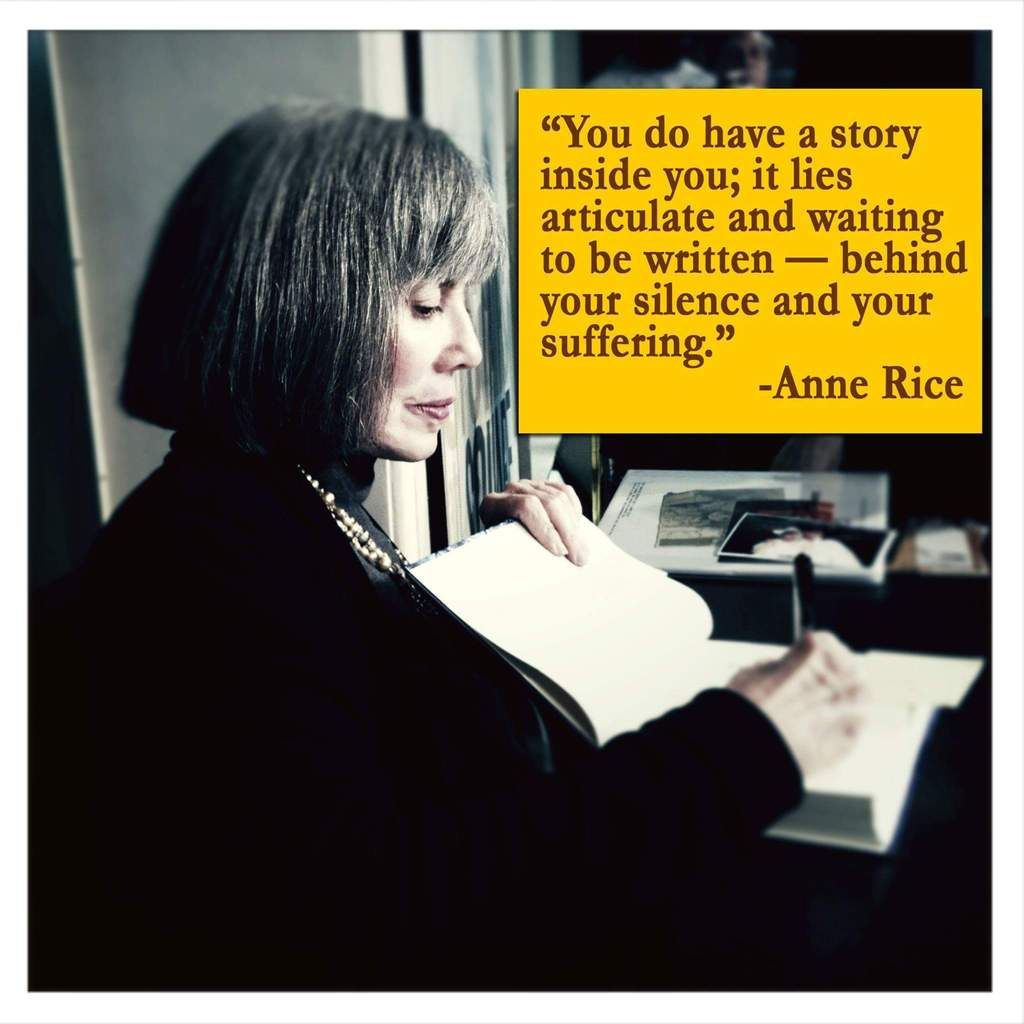
Anne has great advice for when the writing dries up and you are hit with writer's block. She said that one thing to do is to simply, write. Pick up the pen and write. Write through the block. I think this is the simplest, most powerful advice that truly blasts block to smithereens.
Believe in yourself and tell your story.

Believe in yourself and tell your story.
Monday, February 8, 2016
Formal education

We have to point out here that Anne is well educated. She earned her B.A. in Political Science in 1964 from the San Francisco State University, and in 1972 graduated with an M.A. in Creative Writing. Still, she gives this selfless advice and opens the door wide for all wannabe writers, such as myself.
This one hits pretty much closed to home, because I have never earned a bachelor's degree and have consistently failed in college. It's wise words like these that inspired me to keep reaching for my dream in spite of not having a diploma.
I am happy to report that this year, 2016, I'll be a published novelist, and also working on new novels. The only one that can stop as from being writers is ourselves. So, don't. Pick up your pen and write that story that wants to pour itself out of you onto the page.
Sunday, February 7, 2016
Have nerve
Whenever I feel blocked about my writing, I go back to Anne's writing advice, and there's lots she gave on her YouTube channel. Among the many novelists who talked about the writing process, Stephen King, Ursula K. LeGuin, Natalie Goldberg, Julia Cameron, it seems to me that Anne is the least self-serving, least self-mythologizing, and completely selfless in her encouragement of those who wish to take the trail the writing path.
I think it's because, no matter how far along she's gone in her writing life, she's never forgotten how she started, and so her advice is always valuable, always pragmatic. This one here, is one that I often return to. Thanks to Becket for making these memes.

I think it's because, no matter how far along she's gone in her writing life, she's never forgotten how she started, and so her advice is always valuable, always pragmatic. This one here, is one that I often return to. Thanks to Becket for making these memes.

Saturday, February 6, 2016
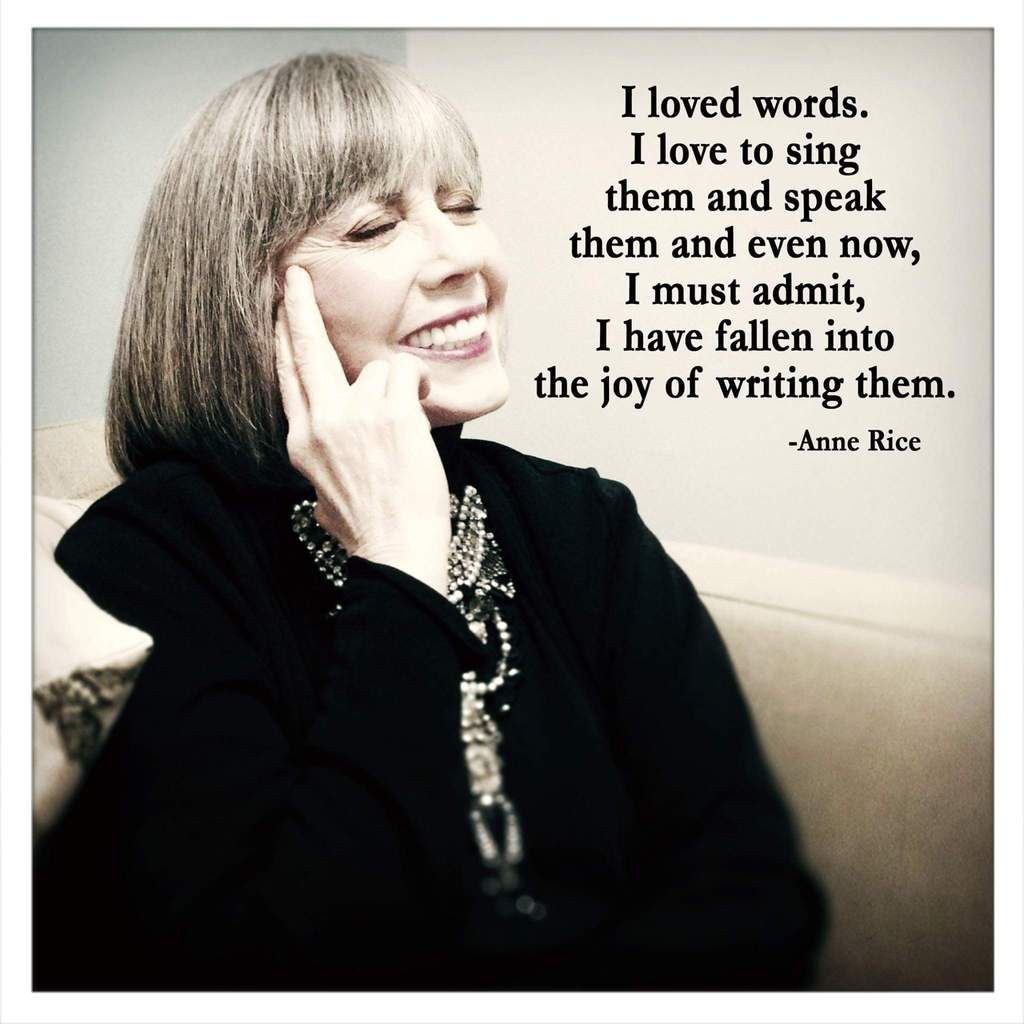
I loved words
Anne is on an extended hiatus from the Page right now to recover. Since then, our man Becket has been keeping the Page busy with wonderful memes and articles and updates from Anne. Becket came up with an Anne On Writing series, and for the sake of posterity, I wish to re-post those priceless memes here. Here's the first.
 And we have fallen into the joy of reading your words, Anne. You do make words sing. Your prose brings out the richness of melodies and harmonies, recalling Dickens and Shakespeare. People who say otherwise, like Terrence Rafferty, must be tone deaf.
Subscribe to:
Posts (Atom)